All-Black Outfits for Men: Why Black Only Works With Texture
Black on black is the simplest idea in menswear and one of the most often badly executed. The difference between a uniform and an outfit is not the colour but fabric, proportion and three small decisions.
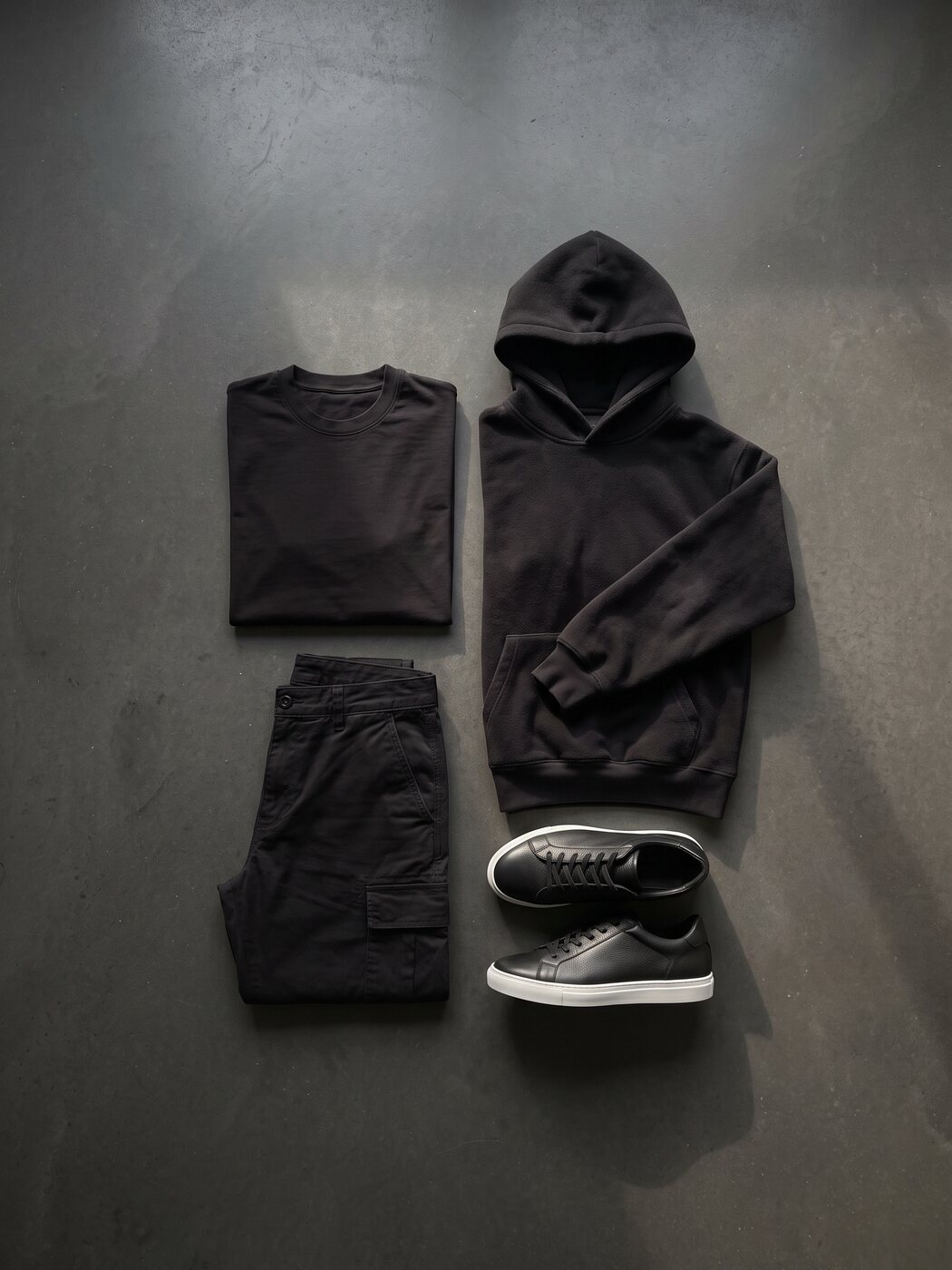
An all-black outfit has an unfair advantage: it cannot clash. Which is exactly why you see it go wrong so often. Five black pieces in the same thin jersey do not make a look; they make a surface. What black needs to work is everything colour usually delivers: contrast, depth, rhythm. Just from other means.
The texture rule
Without colour, the fabric does the work. A good all-black outfit combines at least two, better three, different surfaces: matte and slightly glossy, smooth and structured, heavy and light. Heavy cotton next to nylon, a ribbed collar next to smooth jersey, a sweat fabric next to twill. The eye reads each of those edges as a line, and lines make a silhouette.
The most common mistake is not too much but too little: T-shirt, hoodie and joggers in the same fabric quality. The outfit then has no edge for the eye to hold. A heavy shirt falls differently from a light one and draws a line by that alone.
The three shades of black
Black is not one colour; it is at least three. There is the deep, saturated black of a new, heavy fabric. There is the slightly washed black that drifts towards anthracite after twenty washes. And there is the cool, almost bluish black of synthetic fabrics. All three side by side look restless, because the eye reads the deviation as accident.
The rule: at most two shades per outfit, and the difference should look intended. A saturated black top with slightly faded trousers works. Three different blacks across three pieces read as a mistake. How to keep that saturated black as long as possible is in our guide to washing printed shirts: cold, inside out, no heat.
Proportion: one silhouette, one dominant piece
Because colour drops out, proportions show more clearly in black than in any other outfit. The basic rule is the same as for any oversized cut: one wide piece dominates. Wide hoodie, straight trousers. Wide cargo, shorter top. Both wide only when the top is short enough for the waistband to stay visible.
A detail that counts more in black than elsewhere: length. A black top that is too long eats the legs, because no colour edge marks the transition. A hem that ends at the hip bone gives the silhouette back the break that colour does not provide.
Three details that decide everything
- One print or none. A graphic shirt under an open hoodie is the only accent a black outfit needs. Two prints compete, and the look loses its calm.
- The shoes carry the contrast. Fully black sneakers turn the outfit into a uniform. A white sole, a grey tone, leather instead of mesh: small deviation, large effect.
- Metal, sparingly. One zip, one buckle, one ring. More quickly becomes costume in black.
Four formulas from the wardrobe
1. The standard
Heavy black T-shirt, straight black trousers, sneakers with a light sole edge. The Black Tee is made for exactly this role: a shirt that forms a silhouette through weight and cut alone. Nothing about it is loud, and that is precisely why it works daily.
2. The layer
Graphic shirt, an open or half-closed hoodie over it, straight trousers under it. The Pray Black delivers the one print; the hoodie delivers the second texture. The hoodie stays plain, or two statements fight for the same glance.
3. The wide one
Oversized hoodie with straight trousers: the NEUN Hoodie as the dominant piece, with quiet trousers and a plain shoe. Everything else steps back. How a hoodie should fit for this is in the hoodie guide.
4. The bottom-heavy one
Wide cargo or joggers as the dominant piece, a heavier, shorter shirt and a flat shoe. Here the trousers carry the texture: pockets, seams, drawcord. The top may be smooth.
When black is not the answer
In strong sunlight every black turns to anthracite and every texture disappears. Then a tone like sand or stone helps as a break, the way the quieter half of our house wears it. And whoever wears black every day should do it out of conviction, not convenience. The difference is always visible in the end.
Frequently asked questions
How does an all-black outfit not look boring?
Through texture instead of colour: combine at least two different surfaces, such as heavy cotton with a smooth or slightly glossy fabric. Add at most two shades of black, a single print as the accent and shoes that set a small contrast, such as a light sole.
Can you combine different shades of black?
Yes, but deliberately and at most two. A saturated black top with slightly faded trousers looks intended. Three different blacks across three pieces read as accident and make the outfit restless.
Which shoes go with an all-black outfit?
The shoes carry the contrast. Fully black sneakers turn the look into a uniform; a light sole edge, a grey tone or leather instead of mesh sets the necessary break without disturbing the calm of the outfit.
Does oversized work with a black outfit?
Very well, because black emphasises the silhouette. The rule stays: one wide piece dominates. Straight trousers with the oversized hoodie, a shorter top with wide trousers, so the waistband stays visible.