How Should a Hoodie Fit?
A hoodie forgives a lot, but not everything. A few centimetres at the shoulder and the hem separate relaxed from borrowed. How to recognise a good fit, where oversized ends and shapeless begins, and how to pick your size.
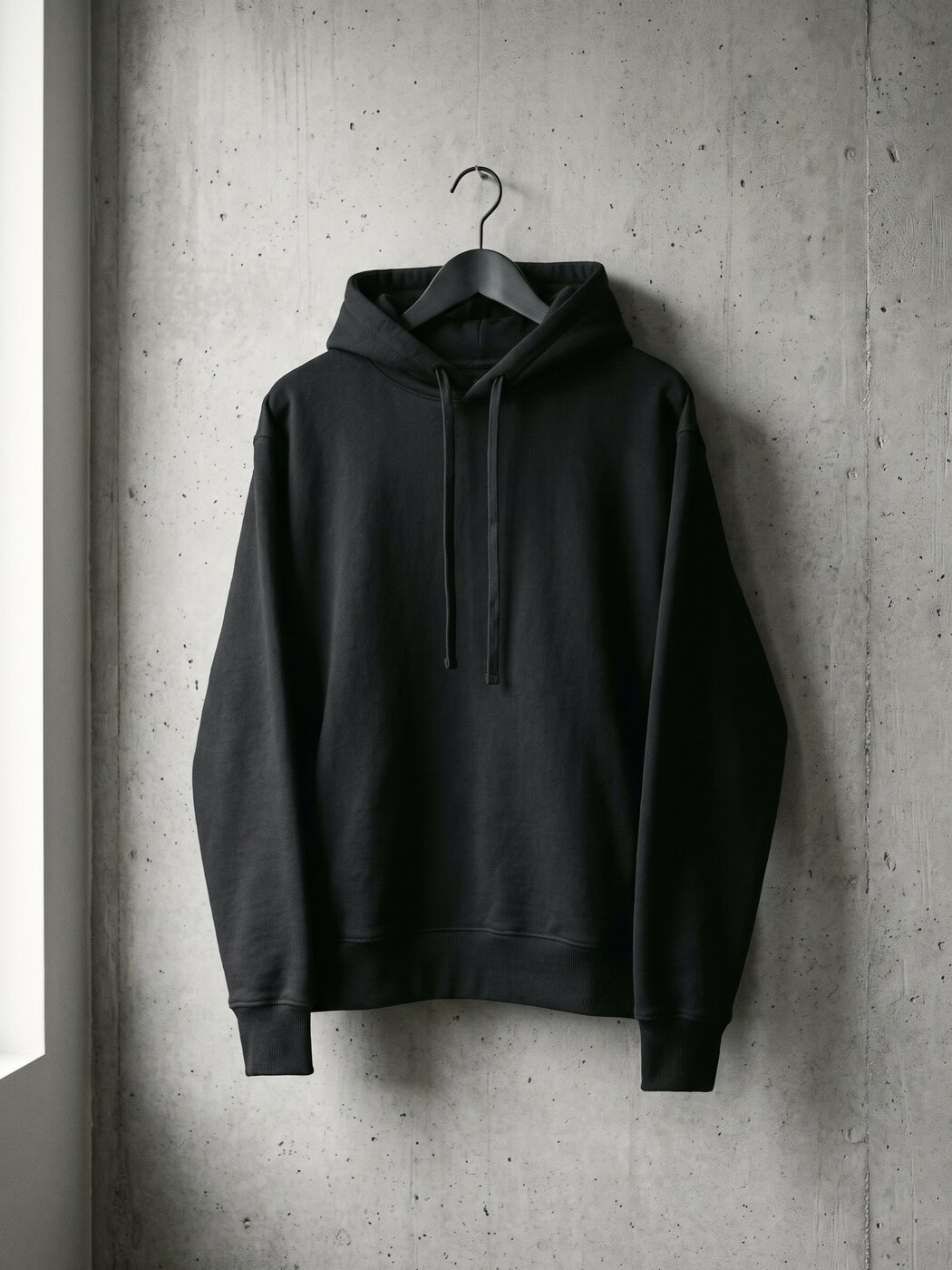
Few garments are worn in the wrong size as often as the hoodie. Not because people do not understand fit, but because a hoodie almost always works somehow. It is soft, it is warm, it has pockets. Whether it looks good is decided at five points that, with a little practice, you check in two seconds in front of the mirror.
1. The shoulder seam
The shoulder is the most important checkpoint, even more so on a hoodie than on an oversized T-shirt, because the thicker fabric emphasises every deviation. On a classic cut the seam ends on the shoulder bone. On an oversized cut it deliberately falls past it, usually five to ten centimetres down the upper arm.
How you know it has gone too far: the seam wanders towards the elbow, and the hood pulls at the neck because the neckline slides with it. Then the hoodie is not oversized; you are in a hoodie that is too big. The difference is visible, even to people who cannot name it.
2. The hood
A good hood stands slightly at the neck and does not lie flat like a collar. Worn up, it should reach the forehead without blocking your view, and fall back without pulling at the head. Two layers of fabric in the hood are a mark of quality: it holds its shape even when it is not worn.
A common fault on hoodies that are too big: the hood becomes so large that it forms a pouch on the back. That is not an oversized effect; it is a fit error.
3. Body length
As a guide, a hoodie ends between the hip bone and the middle of the seat. An oversized cut may go to the lower end of that range; a regular cut stays at the top. If the hem heads towards the thigh, the silhouette tips: the legs look shorter, the torso longer, and the hem band sits where it has nothing to hold.
A simple test: raise your arms. If the band rides over the waistband and exposes the stomach, the hoodie is too short. If you sit down on fabric, it is too long.
4. Sleeves and cuffs
The sleeve ends at the wrist; the cuff may sit slightly past it. On oversized cuts the sleeves are deliberately a little longer, because the lower shoulder point would otherwise shorten the sleeve. What should not happen: a cuff that reaches over the palm, or one so wide it does not hold at the wrist. The cuff is the anchor of the whole sleeve. If it sits, the rest may be wide.
5. The body
Between fabric and body there should be a flat hand of room at the chest, more on an oversized cut. The fabric should fall straight, neither strain nor stand off like a tent. Heavy cotton helps here, because it falls under its own weight and forms a silhouette instead of clinging. A thin hoodie in the same size quickly looks shapeless.
Oversized or regular: the difference is in the cut
An oversized hoodie is not simply a big hoodie. It is constructed differently: a lower shoulder seam, a boxier body, a wider armhole, often a slightly shorter body so that width does not tip into length. A regular hoodie two sizes up brings width, but the proportions are off, because the shoulder construction is missing.
| Checkpoint | Regular | Oversized |
|---|---|---|
| Shoulder seam | on the bone | 5 to 10 cm below |
| Body length | to the hip bone | to the middle of the seat |
| Sleeves | at the wrist | cuff slightly past the wrist |
| Chest room | a flat hand | noticeably more, fabric falls straight |
| Hood | close, stands slightly | larger, but no pouch on the back |
Which size to choose?
- The hoodie is cut oversized: take your normal size. The width comes from the cut. One size up only if you deliberately want to push the effect and the shoulder still carries it.
- The hoodie is a regular fit: one size up gives a more relaxed fit, but not a true oversized fall.
- You wear it over layers: allow room for a T-shirt and a long sleeve. On oversized the normal size is enough; on regular, one size up can make sense.
- You are between two sizes: on oversized, the smaller, so shoulder and hood stay controlled. On regular, the larger, because a straining hoodie looks worse than a slightly wide one.
The NEUN Hoodie is an example of a cut deliberately built oversized: the width comes from the construction, not from the size. Choose your normal size there and you get the fall the piece was made for.
The proportion rule
A straight or slimmer trouser to a wide hoodie; a shorter or closer hoodie to a wide trouser. Both wide only works when the hoodie is short enough for the waistband to stay visible. One silhouette, one dominant piece: that is the whole rule, and it applies to shirts just as it does to hoodies.
Frequently asked questions
Should I buy an oversized hoodie one size up?
No, usually not. A hoodie constructed as oversized brings the width through the cut: a lower shoulder seam, a boxier body, a wider sleeve. Take your normal size. One size up only if you deliberately want to push the effect and the shoulder seam does not then slide towards the elbow.
How long should a hoodie be?
As a guide it ends between the hip bone and the middle of the seat. An oversized cut may go to the lower end; a regular cut stays at the top. If you sit down on fabric or the hem heads towards the thigh, it is too long.
How do I know a hoodie is too big?
Three points: the shoulder seam wanders towards the elbow, the hood forms a pouch on the back, and the sleeve cuff reaches over the palm. Then it is no longer an oversized effect, just a hoodie that is too big.
Which hoodie size if I am between two sizes?
On an oversized cut, the smaller, so shoulder and hood stay controlled. On a regular cut, the larger, because a straining hoodie looks worse than a slightly wide one.