How Should an Oversized T-Shirt Fit?
Oversized does not simply mean bigger. A good oversized cut is its own construction with its own rules. How to tell whether a shirt falls right, and how to pick your size without guessing.
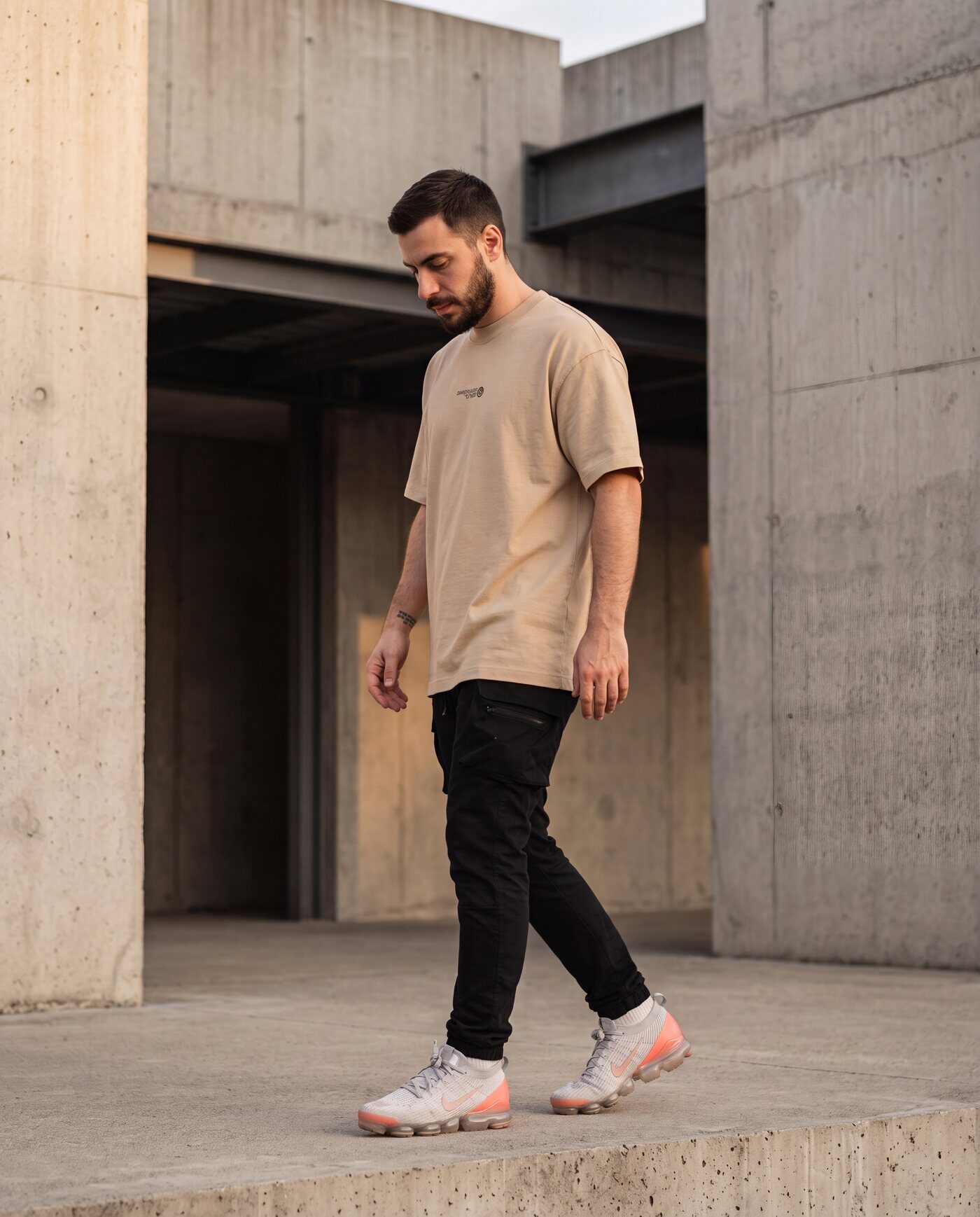
The most common mistake with oversized shirts: just buying two sizes up. The result rarely looks intentional, because a regular-cut shirt in XXL is only a shirt that is too big. A real oversized cut shifts the proportions on purpose: the shoulder drops lower, the body is boxier, the sleeve is wider. Size then only controls how strong that effect is.
The shoulder seam: the point that matters most
On a classic cut, the shoulder seam ends on the bone. On an oversized cut it falls past it, typically three to eight centimetres down the upper arm. This is where the look is made: the dropped shoulder softens the silhouette and lets the shirt fall instead of sit.
How you know it has gone too far: if the seam wanders towards the elbow, or the neckline slides off the neck towards the shoulder, the shirt is too big. It no longer looks relaxed; it looks borrowed.
Length: the line between statement and nightshirt
As a rule of thumb, an oversized shirt ends between the hip bone and the middle of the seat. It may be longer than a regular fit, but it remains a shirt. Two simple tests:
- The sitting test: Sit down. If you are sitting on several layers of fabric, it is too long.
- The movement test: Raise your arms. A good oversized cut gives freedom of movement without the hem climbing past your navel.
Oversized is a proportion, not a garment size. The cut does the work, not the XL on the label.
Sleeves and collar
The sleeve of an oversized shirt ideally ends between mid-bicep and elbow and stands slightly away from the arm. A sleeve that clings to the arm gives away a regular cut in too large a size. The collar should hold its shape even on a wide cut: a densely knitted, double-layered collar is one of the most reliable signs of quality, because it costs more to produce and does not stretch out after the third wash. More on material quality in the guide on heavyweight cotton.
Why the fabric is half the fit
A wide cut in thin fabric clings to the body and creases without shape. Only a heavier fabric, roughly from 220 gsm up, gives an oversized cut the structure it needs: it falls straight, holds the boxy shape and does not stick. That is why good oversized shirts are almost always heavy cotton. The extra weight is not a side effect; it is part of the construction.
Which size to choose?
Three starting points, three answers:
- The shirt is cut as oversized: Take your normal size. The cut brings the width. One size up only if you deliberately want to push the effect and are taller than about 1.85 m.
- The shirt is a regular fit: One, at most two sizes up gives a more relaxed look, but not a true oversized fall, because the shoulder construction is missing.
- You are between two sizes: With an oversized cut, usually the smaller one, so collar and shoulder stay controlled.
Our shirts, such as the 2Pac graphic tee or the Pray Tee, are built as oversized silhouettes. If you are torn between two sizes, write to us; we answer with an honest assessment, not sales logic.
The proportion rule for styling
The simplest everyday rule: one wide piece dominates per silhouette. A straight or slimmer trouser with a wide shirt, a shorter or closer-fitting top with wide trousers. If you combine maximum width on top and bottom, you need very deliberate lengths, or the look loses its edge. For the culture behind the silhouette, read What Is Streetwear?.
Frequently asked questions
Should I buy an oversized T-shirt one size up?
No, usually not. A shirt constructed as oversized brings the width through the cut: a lower shoulder seam, a boxier body, a wider sleeve. Take your normal size and only go up one if you deliberately want to strengthen the effect.
How long may an oversized T-shirt be?
As a guide: between the hip bone and the middle of the seat. If you sit on several layers of fabric when you sit down, or the shirt reaches towards mid-thigh, it is too long and looks shapeless instead of intentional.
How do I recognise a good oversized cut?
Three points: the shoulder seam falls a controlled few centimetres past the shoulder bone, the collar still sits at the neck, and the fabric is heavy enough to fall straight. A regular-cut shirt in too large a size meets none of these.